








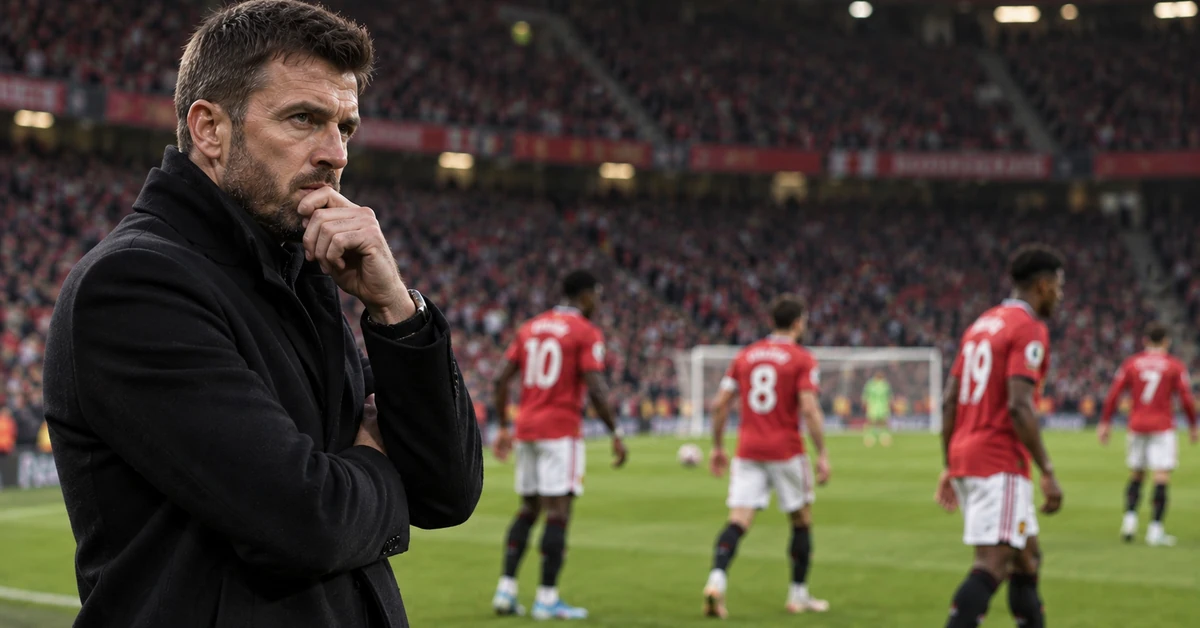
Michael Carrick’s decisions are coming under increasing scrutiny after Manchester United won only two of their opening seven matches.
Much of the criticism following the draw with Fulham has focused on the players, particularly United’s poor running statistics.
But Manchester United correspondent Samuel Luckhurst has highlighted another question: has Carrick made his own job harder by changing several elements of the team that worked last season?
One of the clearest examples is Matheus Cunha.
Cunha was highly effective from the left during United’s strong finish to last season, but Carrick has moved him away from that position during the opening weeks of the new campaign.
Bryan Mbeumo has also returned to the right despite showing his effectiveness through the middle.
Those changes have altered an attacking structure that produced results during Carrick’s successful first months in charge.
Benjamin Šeško’s use has also attracted criticism.
Luckhurst argues the striker was introduced too late against ten-man Manchester City, while Carrick also moved Bruno Fernandes deeper as United attempted to chase the game.
Carrick then made eight changes against Brighton before again reshuffling his team.
Joshua Zirkzee has repeatedly been used from the bench, while other options have struggled for opportunities.
Against Fulham, however, Carrick went in the opposite direction and returned to essentially the same side he had previously trusted.
There is a notable pattern in his team selections.
Carrick has started the same XI against Ipswich, Everton and Fulham.
United won one of those matches and drew the other two.
The back four of Diogo Dalot, Harry Maguire, Lisandro Martínez and Luke Shaw has also remained intact for those games despite concerns about United’s defensive vulnerability.
None of those decisions individually explains United’s poor start.
Managers routinely change positions, rotate teams and make substitutions based on opposition, fitness and the state of individual matches.
The concern raised by Luckhurst’s analysis is the cumulative effect.
Carrick inherited a team that produced 39 points from 17 Premier League matches during the second half of last season.
Several of the roles and combinations behind that run have since changed.
Cunha has moved away from the left. Mbeumo has shifted back to the right. Šeško’s introduction has required further changes to the attack, while Carrick has alternated between heavy rotation and returning to familiar selections.
United’s results have deteriorated at the same time.
That does not establish Carrick’s decisions as the cause, but it puts his management of the squad firmly into the debate surrounding United’s start.
The question is no longer simply whether the players are performing well enough.
Carrick’s choices are now being examined too.